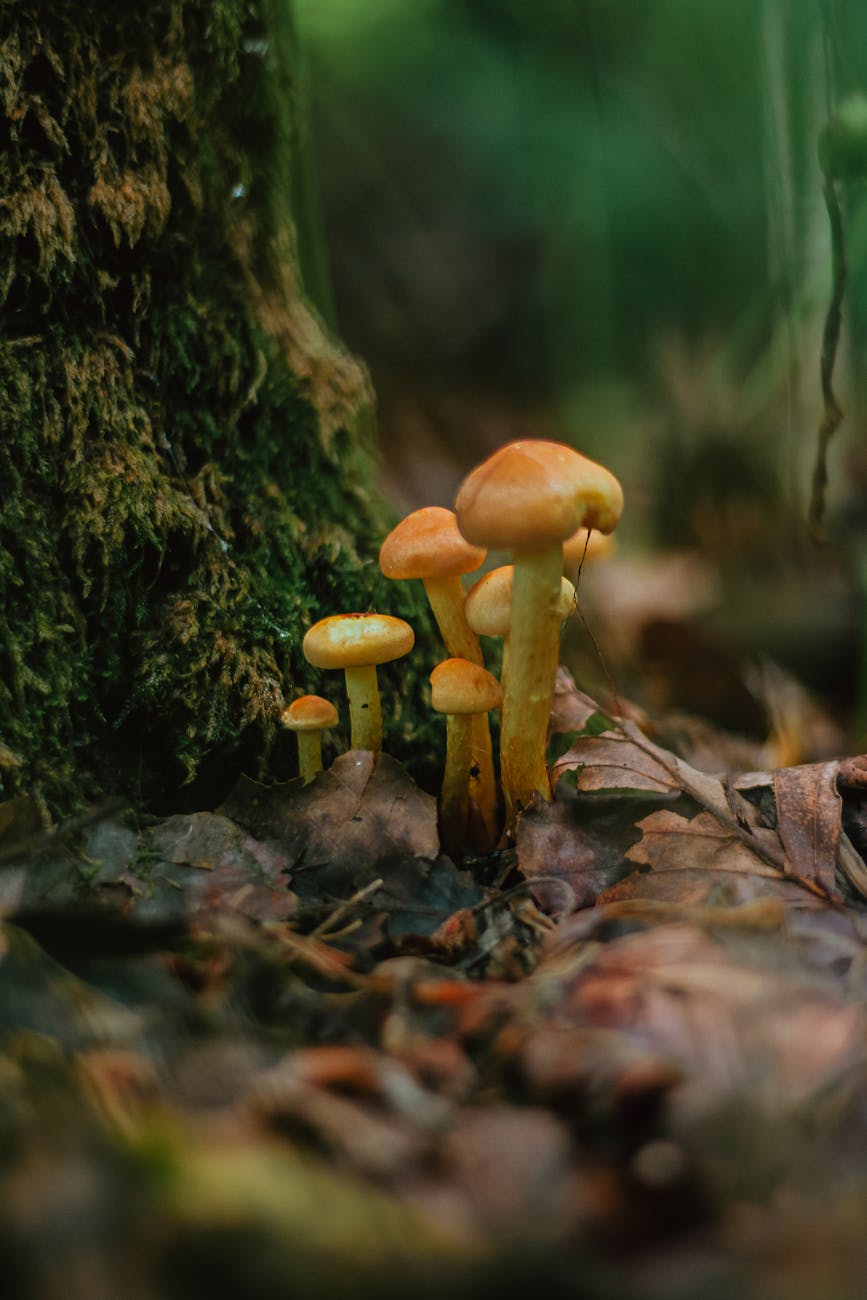
By Mary Grace van der Kroef
Originally published in 2021 as “Our Forest on an Artist’s Conk,”
It had been eating me. Using me. But that is the way of nature. It took a part of me with it when she pried it from my bark.
I watched her place it carefully into her bag. The canvas cradling its treasures. Collecting her treasure meant its death. Did she know that? Did she care?
She walked away. Part of a corps of my brethren held firmly in her hand, supporting her steps across the uneven ground. She used it to search for my protruding roots to avoid a fall.
Little bits of me lay scattered across the forest floor like a carpet. They had long since lost their green and yellow and turned to a rotten brown. She pushed aside their decaying bodies and tapped a large root with her supporting corps. Was it a goodbye?
She didn’t live far. It was just a few minutes’ walk to the house, to stoke her furnace with more chopped pieces of my dead relatives. I smelled them in the smoke, and by it I remembered them.
The piece of me it carried was small. Strange how I could feel her stroke it as she places it on a shelf by the furnace to dry.
Her little house was warm. It wouldn’t take long for the dry wood heat to suck the water from its body. It would be a slow death, still it was content. It had fed from me enough and was now ready. Ready for death, and it was a good death for a mushroom.
She was an artist. As the fungus lay there drying, its awareness faded. With that awareness, my tendril frayed. The bit of me was also dying. But before I lost it, there were flashes of colours from her cabin’s walls. Smells of earth permeated her dwelling from potted plants she kept captive but allowed to thrive. Bits of dead trees streaked with vivid colours in human shapes and patterns, carved in to various shapes hung in walls. A human home is a strange place.
As she poured water over dried leaves, my tendril snapped. But it wasn’t my only ear in to her home. My roots reach far, and where they can’t go, my brethren whisper to me of the goings on.
I listened to my neighbour speak of the iron beast that rumbled up the widened track to her house. It always carried the same human in its belly. This human would cry out, “Auntie!” as she opened the iron door. I never needed my neighbour’s help to hear her cry. It echoed through us.
This time was no different. Her greeting bounced back and forth against our trunks, propelled further in to the forest off of smooth bark, and sinking in to the rough bits to shiver down through roots. Loud and happy.
“Auntie! I got the job! Auntie! Can you hear me?”
“I can hear you!” Came a muffled response. “Let an old woman finish doing her business.”
The visitor laughed. Sounds of plumbing gurgled, then Auntie opened the front door.
“Your early.”
“I got the job!”
“Oh, Bee! That’s wonderful!”
Auntie was happy. Her heart beat thrummed with it and echoed through the dirt her now bare feet had settled in to just off the front door steps. But the bushes under the front windowsill whispered of the tear she shed.
“When are you leaving then Bee? It’s a long trip.”
“Not until Monday, Auntie. Can I stay the night?”
“Of course. I will make mushroom soup. I just picked them fresh.”
Door hinges squeaked as they closed behind the women muffling their voices. But the bushes hugging the house whispered of their conversation.
Humans never truly ceased to make noise. Even in their sleep. They were a constant chatter, a vibrating heart beat, a fluttering presence in a solid world.
“An exciting new chapter for you. When is your first day of work?”
“Thursday. I have orientation and training. Then that next Monday I will be on my own.”
“I need to dress business casual?”
The wind picked up as the earth continued its spin and tilted us away from the burning sun. It whispered through my branches, drowning the women’s chatter. I could still hear clattering of pots and pans, running water, and the swish of something being stirred with a wooden spoon. The sound of wood on metal and metal on wood is very different. One chinks of usefulness, the other thuds like finality.
The smell of warmth, liquid, fungus, earth, hot cream and chive, all mixed, seeped through the cracks of the little house to be whipped away by the wind.
Bee threw open a window in a coughing, laughing fit.
“Take it easy with the garlic Auntie!”
“Why? It’s good for you?”
“With that much, I will smell until my first day of work!”
The human’s breathless giggles melded with the whispering chatter of the forest. The forest laughed at their silly ways and marvelled at the simple beauty. Two women in rhythm. Each enriching the other’s existence. Their happiness was a song.
The forest went about its nightly existence. The grasses, vines, and shrubs readied themselves for sleep. Insects, rodents, small mammals, found their place of rest, or stretched awake for a night of feasting. I and the other trees watched, listened, grew. We tucked our charges in safely. New growths formed on my trunk where Auntie had pried her treasure free. There were small white mushrooms beginning in the shelter of my exposed top roots. I whispered my hello to them. My crumbling decaying leaves would feed them well and Auntie would no doubt find them soon.
The creak of her wooden door broke through the mounting darkness.
“It’s getting cold. Fall is almost over I think.”
Bee pulled a heavy knit sweater around herself as she settled to sit on the doorstep.
“Yes. It is getting harder to find new growths on my daily walks. The spores are starting to sleep.”
“Sleep?”
“Sleep, or die. In a forest there isn’t much difference. The earth uses everything.”
“Don’t be creepy, Auntie.”
“Creepy? I find it comforting. You won’t forget the earth, will you, Bee? Toronto is a busy place filled with noise, cement, lights, and people. If you’re not careful, you’ll forget.”
I could tell Auntie accepted the change that was coming. Her voice drifted with sad ripples. But knowledge doesn’t always ease pain.
“It’s okay to grow. You must grow, change, learn, find your own way. But don’t forget.”
Auntie’s arm slipped behind her niece as she too settled down in the doorway. The glow of their warmth joined as the elder held the younger in a protective embrace.
“I won’t forget Auntie.”
Now the bushes under the windowsill whispered of both their tears.
Bee strapped herself into the beast of metal after a late breakfast. The clouds had gathered and the drops of rain fell as she rumbled out of our forest.
Auntie stood at her door and waved until the beast was out of sight. Her sigh held resigned sorrow.
Her grey hair was turning white. I remembered how dark it had been when she first built the little house. She hadn’t lived alone then, but he hadn’t stayed. She never left our forest for long. Her pantry was well stocked, or so the house mouse chirped.
She loved us, and we loved her. There was a change coming. I felt it in the wind that kissed my last few leaves. Auntie felt it too. She whipped away a tear and closed herself in to the warmth of her home. Curtains were closed, an extra log thrown in to the fireplace, then quiet.
Drizzle soaked everything for the next few days. It was never a hard rain, but each twig and leaf sagged with the constant drip. The small white mushrooms at my feet grew and then died. A life almost too quick to note. But I did. Auntie had missed them. Not all change is pleasant, but it is inevitable. The forest sensed the change. The little house sagged with the constant drip. She dimmed the light within. The sounds of human habitation, faint. An aura of twilight settle on windowsills and hide in eves. Still it rained.
It has been almost a week since Auntie had opened her door. Even the neighbourhood rabbits had wondered up to her steps to sniff at the house timbers. Was she will there? She was, but when she emerged, she looked smaller than she had been. Something wasn’t right, something smelled off.
The earth sunk beneath her boots. Moisture had turned it to mud. My branches hung heavy with mist. The air was chilling. But it was good to hear her trudging down the rabbit trails. It was good to see her come in to view, coat buttoned closed and cinched tightly around her middle. Woolen tuque pulled well over her ears. Cold had already kissed her nose pink. Her water grey eyes searched for me through the trunks.
“Hello Elder.”
Her greeting was faint. Her bag dropped at my roots as she slipped a hand from knitted gloves. Warm human flesh thrummed with her hello far louder than her voice.
“I have something to show you.”
What is it, little sister?
“Here, I have brought it back to you.”
From her bag she slipped the body of her treasure. The back of it was banded shades of brown. The base where it had attached to me was rough. There, remnants of my bark still clung. She flipped it over to show her etchings. Delicate scratches scrawled across the mushroom’s face. They were now dry and set. Her wood heat had dried it fast.
“See here, I have drawn you, my old friend. Here, the creatures that call you home, and here my little cabin. All one, like we have been for these last 50 years.”
Well made little sister.
Can a Maple, as old as the forest, understand human art? I may not understand the need to leave images in a tree mushrooms flesh, but I understood the love in her voice. The heartbeat thrumming through her touch on my bark spoke volumes. This was a goodbye.
She slipped her treasure back into her canvas bag.
“I have decided where to die.”
It was cold, and the earth wet, but she slipped off her boots, anyway. Blue-veined feet sinking slightly in to the dirt. My roots kept the ground around me solid.
Next she slid down my trunk. Her soft human bottom finding a home among my roots as well.
You are welcome here, little sister. You have missed the last of the white spoors. They fell asleep while you were resting.
“I didn’t tell Bee before she left. I knew it was coming, but not this soon. Her mother will come soon, but too late. I do not wish to pass surrounded by white walls and plastic tubes.”
She buckled her canvas bag closed and rolled down the top.
“The Artist’s Conk will last until she finds it.”
She settled up against my trunk, eyes closed. A shiver went through her from the chill at her feet. But she ignored it as her breathing slowed.
Time passed slowly for her, but she didn’t move. Night came. Her eyes had never opened again, her breathing swallowed to barely a wisp.
Goodnight, little sister.
Soon the moon was high and the air bitterly cold. The woman at my feet was quiet. The quietest she has ever been. Her heart and stopped.
We sang to her. I, the Maple, my neighbours Beech. Down the lane, Evergreens joined in. Then I felt her. A whisper against my trunk, a shimmer in the wind.
Little Sister, where are you going?
She slipped up my trunk and through my branches with the early morning breeze.
Home Elder Brother. Home. I love you.
A Maple tree has never known such love.
Acknowledgments:
April 15, 2021 ‘Our Forest on an Artist’s Conk‘, a short story, was published online by Hencroft Hub, in their ISSUE ONE themed ‘fungus’. (Please note that this online publication had since closed its doors.)
 Mary Grace Writing