On Friendship: What if You’re Afraid of It?

Fear of deep friendships is a very real thing in our modern world. Not only is it difficult and requires time and love to keep alive, but it also has the potential to leave deep and lasting wounds in its wake when abused.

Do you hold scars from past friendships? Have they healed? Have you abused friendships and left chaos in your wake? Most of us carry scars as well as guilt in that regard. Do these scars hold you back from seeking new friendships? How can we work past the obstacle of fear?

It starts with having honest conversations with ourselves while confronting painful memories.

I don’t want anyone to pile blame on themselves for something that wasn’t their fault, but it’s still important to examine how things fell apart. Is there something we could have handled better? Could we have been more honest with our friends from the beginning? Do we share in the blame, or where we trapped in an abusive narcissistic friendship? Were we the ones in the wrong? Should the blame be shared between both parties?

If after self-examination you find yourself guilty, it’s important to accept it. Don’t run away from the fact you have made mistakes. Being able to recognize this failure shows maturity and the potential for great growth. Now it’s time to decide if you need to seek professional counselling so you can honestly identify the why. Don’t let this scare you. You are still worthy of friendship, you still need it and you can learn to have healthy relationships while correcting your behaviour.

Did you find yourself innocent? If you’re sure, then the next question is were there red flags about the friendship that you missed? Are there things you need to learn to be careful of moving forwards? Was it a one-time mistake or does this person who hurt you make a habit of sabotaging friendships? Do you make it a habit of welcoming people into your life who abuse your trust? If this is a pattern, it’s also time to seek professional counselling. There is no shame in asking someone to help you learn how to build healthy boundaries in relationships, and it is really important to know that not every person who is looking for friendship will hurt you like you may have been hurt in the past. It is possible to find true mutual friendship. Don’t let fear stop you from shining your light and finding each other.

If you’re like most people, myself included, you may realize you hold a measure of guilt as well as having suffered some brutal wrongs. If so, it’s time to ask yourself if you started the situation, or ended it? Did you lash out when hurt? Did you strike first out of fear? Is this up and down a pattern for you? If you identify this as a rut you have fallen into its time to get out of it. How? Again, ask for help from a counsellor who will be honest with you.

Don’t wear shame as a beacon warning, or a shield against the world.

It’s time to trust again. It’s time to learn how to be a safe place for others instead of guarding against every small jab that might leave a mark. It’s also time to learn proper boundaries so that we are not crushed every time a friendship hits a bump in the road. It’s time to take responsibility for our own actions, whether good or bad. It’s time, to learn how to be friends, true friends, lasting friends, in a world that is forgetting about what it really means.

To learn these things, we must stop being afraid of each other.

I have been guilty of a lot of fear over the last few years. I have been struggling to trust again after misunderstandings, betrayals, and some selfishness. I think this is probably why I felt compelled to write this series on friendship. If you too are struggling with friendship in this way I want to encourage you. People are precious, you are precious and worth fighting for. Your friendship is a gift, a gift worth giving, and there is someone out there in this world that NEEDS it. Beyond that, there is someone in this world that wants it and you in their life.

We were created for a relationship. I pray my words shine a little bit of light in the darkness of that search to reclaim true friendship.

What are your thoughts? Do you have a story of letting go of fear and reaching for friendship? I would love to hear about it.

Copyright ยฉ2023 Mary Grace van der Kroef


Previous Post โ€“ On Friendship: Friend Doesn’t Mean Project

Previous Post โ€“ On Friendship: In Person

Previous Post โ€“ On Friendship: Virtual Friendship

Previous Post โ€“ On Friendship: Receiving and Giving Forgiveness

Previous Post โ€“ On Friendship: The Word Enemy

Previous Post โ€“ On Friendship: My First Friend

Previous Post โ€“ On Friendship: What is it?

Previous Post โ€“ On Friendship: The Word Friend

Previous Post โ€“ On Friendship: Introduction

Forthcoming Post โ€“ The Power of One, The Weakness of Many


On Friendship: Receiving and Giving Forgiveness

How to say โ€œIโ€™m sorryโ€ is one of the most important lessons we learn as children. But saying the words and actually meaning them doesnโ€™t always come naturally. Itโ€™s hard.

Telling someone we forgive them is the next important lesson we learn. But again, do we really mean those words when we say them? Thatโ€™s also hard.

Both phrases are ones Iโ€™ve used a lot during my 35 years of life on this earth. When you grow up in a large family, itโ€™s just a way of life as you constantly interact with other peopleโ€™s space, property, and hearts. I learned how to say Iโ€™m sorry, but I also learned how to fake it. (Yes, I was a huge stinker as a little girl.)

The need to use the words โ€œIโ€™m sorryโ€ hasnโ€™t decreased with age. In fact, itโ€™s become more important as I live alongside my husband, teach my children the importance of these words, and grow adult friendships. I say them a lot and truth be told, Iโ€™m still learning to mean them every time. Iโ€™m constantly reminding myself that my perspective isnโ€™t the only valid one, so even if I think I shouldnโ€™t have to say it, I still do, because itโ€™s not always about guilt in a situation, but empathy, too.

Iโ€™m also Canadian, and saying sorry really slips out of our mouths all the time.

But when it comes to forgiveness, Iโ€™ve really struggled. I donโ€™t mean itโ€™s simply something Iโ€™ve I hard time saying. No, I mean Iโ€™ve done battle with this concept in my innermost being after the words have already passed my lips. Sometimes the betrayal of others sticks to you like tar, marking your soul just as black as the person who hurt youโ€ฆ

Thatโ€™s why itโ€™s so important. Unforgiveness is a poison that will slowly eat away at your mind and soul. Itโ€™s also impossibly hard to give in its true form, even in the closest of relationships. Itโ€™s something you have to be constantly choosing because even after you think youโ€™ve finally been able to release that โ€˜thingโ€™ or โ€˜personโ€™ or โ€˜situationโ€™ your mind will decide to circle back and give it a good sniff again, just like a dog and its vomit.

So how do you do it? How do you really let your โ€˜I forgive youโ€™ mean what itโ€™s supposed to mean? How do you stop returning to the betrayal, the hurtful moment, or words that have imprinted in your mind, the grief that penetrated past a physical heart to touch your soul?

There is only one way Iโ€™ve learned to do it, and thatโ€™s giving that moment, that memory, that emotion, to the person who has forgiven me the most: Jesus Christ. For someone who doesnโ€™t share my faith that might seem laughable, even weak, and honestly, thatโ€™s okay, because I am weak. But Jesus is strong, and the most forgiving being in the universe. He is also the epitome of empathy, and he understands the pain that draws me back to that vomit pile. He understands the pull for what it really is, grief.

See, as humans, I believe our souls, minds, and bodies are in a constant state of grief. Grief for what once was in our world, and grief in losing our innocence. But I digress, and if someone who has a different belief system, then I would like to invite them to share how they forgive in the comment section.

โ€“

So what does giving forgiveness actually look like apart from saying the words โ€˜I forgive youโ€™?

Well, itโ€™s not giving people a free pass to walk all over you again. But it can look like inviting them back into your life and home and trusting them again. It doesnโ€™t have to though. Some forgiveness looks like upholding boundaries and giving people a chance to prove that they have changed and wonโ€™t repeat their mistakes. It can also be given without inviting the person who did the hurting back to a close friendship. But forgiveness almost always requires action, just like friendship.

When forgiveness is especially hard for me personally, it looks like holding a constant silent prayer on my tongue. โ€œPlease help me forgive. Please help me let go, and trust again. Please help me be wise in how I welcome someone back in to my life. Please help me be brave in how I tell them just what hurts.โ€

True forgiveness requires honesty. You can forgive someone without confronting them about something they have said or done, but giving them a chance to say โ€˜Iโ€™m sorryโ€™, often helps us release that forgiveness in to the relationship. If we chose not to tell the person what they have done to hurt us, then we at least have to be honest with ourselves and not take more of the blame for a situation than needed.

โ€“

Itโ€™s not possible to fully explore forgiveness in one blog post. People have written books on it and still we as humans struggle to understand its depths and how it really works. But letโ€™s move on from giving it to receiving it.

โ€“

It can be equally hard to receive forgiveness as it is to give it. There are many reasons for this and again itโ€™s not possible to talk about all of them here, but two that stand out the most to me are shame and denial.

Some people donโ€™t believe they are worthy of forgiveness, and honestly, none of us really are. That is the beauty of true forgiveness though, it is an act of pure love.

When a wrong is committed, we canโ€™t go back and change it. Justice demands action. But justice handed out without forgiveness at its right hand can easily turn in to vengeance and spoil the act of justice with traces of hate.

Justice without forgiveness can not bring healing, and often the hardest person to forgive is ourselves. When we have an understanding of what right and wrong is and we know we have committed an offence against a friend, someone we are supposed to care for and love, well, we blanket ourselves in shame. And it is shameful, but we all do it. No one is perfect, and when we deny ourselves forgiveness that friends and family members hand us, we stop healing; sometimes for both parties.

Receiving forgiveness is an act of humility as well. It means we understand we have hurt someone, and this feeds in to the second reason so many of us have a hard time with it. Denial.

When our sorry isnโ€™t real, when we hold on to the idea that โ€œI didnโ€™t mean to hurt you so I shouldnโ€™t have to say those words and donโ€™t truly need forgiveness,โ€ or when we hold on to the belief that we were justified in our actions even if they hurt someone, is cuts forgiveness short.

These are sticky situation that are often so hard to sort out, and really how often are hurts in a friendship the soul responsibility of one person? More often than not, both parties need to give and receive forgiveness at some level. Maybe that is the key to it all, being open to acknowledging how we hurt others even as they hurt us.

This is not a comprehensive guide to forgiveness, but I hope it has started a conversation in your heart as you read it. Typing it out has definite helped solidify a better understanding of it in my own heart. I would love to hear your thoughts on forgiveness in the comment section.

Thank you.

Copyright ยฉ2023 Mary Grace van der Kroef


Previous Post – On Friendship: The Word Enemy

Previous Post โ€“ On Friendship: My First Friend

Previous Post โ€“ On Friendship: What is it?

Previous Post โ€“ On Friendship: The Word Friend

Previous Post โ€“ On Friendship: Introduction

Forthcoming Post โ€“ On Friendship: In Person

Forthcoming Post โ€“ On Friendship: Virtual Friendship

Forthcoming Post โ€“ On Friendship: Friend Doesnโ€™t Mean Project


Processingโ€ฆ
Success! You're on the list.

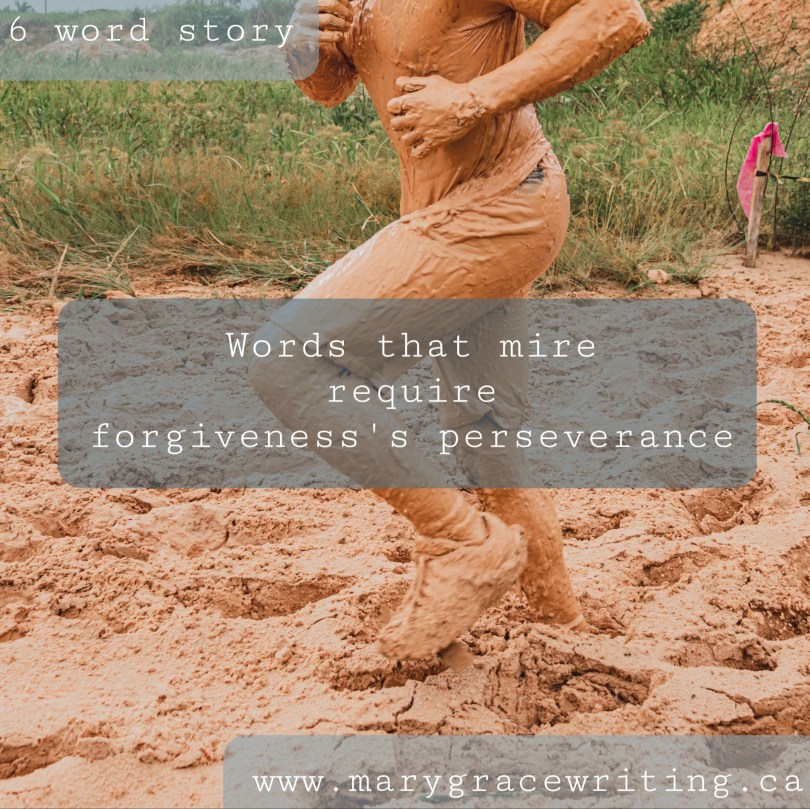
Six Word Story (96)

I am a woman who deals in words and I know their power.

Do you?

They have the power to heal and hurt.

Sometimes they stick like tar that creeps into every crevice, becoming impossible to wash away.

What do we do with such words?

I wash with prayer.

What do you do?

ยฉ2022 Mary Grace van der Kroef

Photo sourced from unsplash.com


Processingโ€ฆ
Success! You're on the list.

Pristine Floor

I turned it over in my hand
This broken piece
Of self
Traced the cracks
Noted the gaps
Counted the missing particles
Now marking
A pristine floor

A broom passed by
Grabbing flecks that soiled
This hallowed place.

Its bristles shush
My shameful grief
Watching
In silence

I should have protested
asked for time
Told my story
Before
This piece of self
Crumbled
And I was left to mourn.

Alone
Or so perceived

Untill
Generous Silence
Gave them back to me
Cupped
In recognition
Bound tightly
With the string of memories
As I prayed

He gave no rebuke
As bits poured into my hands
Losing fragments
Between hesitant fingers
He helped me count the loss
That again littered marble paths
Highlighted against its wealth
As human filth

He waited
Cupping tears that spilled
Adding his own to the soiled floor
Besmirched in regrets as thick as aged blood

Patient
He shushed the onlookers
Ready to jeer the fallen

Then I was ready
He pulled each speck to himself
Dirtying his own hands to lift my loss
Into his apron furled
It was him who shook my remnant free
Of any last dust
It was my King who carried my shame
Out the door
And when returned
Knowing it no more

ยฉ2022 Mary Grace van der Kroef


Processingโ€ฆ
Success! You're on the list.