On Friendship: In Person

Old fashioned, shoulder-to-shoulder, roll up your sleeves together, yell and scream if you need to then make-up kind of friendships, have always been on the scarce side. But today’s world of separation, ‘othering’ of people who believe differently than you, alienated families, and virtual meeting places have almost rendered them visibly extinct. Those of you who still retain the closest of in-person human friendships, please know you are truly blessed.

Fighting for those kinds of relationships is worth every drop of sweat, blood, and tears. But take note I didn’t say peaceful friendships, easy friendships, or quiet friendships, although those kinds are also a blessing and very important. It’s the friendships we must fight for that tend to grow the deepest strongest roots, and in times of trouble as well as calm produce the sweetest fruits. I also don’t believe that this level of deepness can be reached in a virtual friendship.

If you read last week’s post On Friendship: Virtual Friendship you will know I’m in no way against online relationships. In fact, I think they are pretty important in this changing world. But, they should never take the place of in-person interactions if we can help it. Face-to-face communication and connection are what humans were built for.

“Fighting for those kinds of relationships is worth every drop of sweat, blood, and tears. “

So what do modern in-person friendships look like these days? I don’t think casual friendships have changed all that much over the last few decades. It’s still about going out with friends for drinks, catching a movie, and sharing a laugh. Going and doing is still very much a part of it all, especially for younger people. It’s the ‘staying and being’ that I have seen change. We are so busy that we slip friends into the rush of our lives but tend to exclude them from the quiet moments when we come up for breath from the busyness. Have they become just another responsibility we long to take a break from? Friendship is work, and building a friendship to a deep level requires A LOT of time. So yes, we are so busy that the modern human often lumps friends into a group of draining activities. This is true for introverts especially. But I think extroverts are much more tired than they might realize.

Why is this?

We have lost the ability to ‘rest’ in friendship. Of course, this isn’t going to be true for everyone and every relationship, but since relationships take work to build and we are so busy we often don’t have in-person time for each other. Fewer and fewer of us are able to form friendships we can ‘rest’ in. Friendships where you don’t feel like you have to show up looking and feeling your best to participate. Even for an introvert, just being with someone who enjoys your presence so much that the messy living room doesn’t matter, gives you rest. Friendships where you can just be you, and you know you are wanted, friendships where silence is acceptable and the need to entertain each other isn’t constant while still sharing each other’s company, are a lost art form.

I remember those friendships, and I long for them with a deep ache. Have you ever experienced companionship like that?

“Have they become just another responsibility we long to take a brake from?”

This kind of friendship that you can ‘rest’ in is also going to look different for each of us since we all have our unique ways we show love and receiving it in turn. But it’s become exceedingly rare to KNOW someone at that kind of level. We just don’t have time for it.

Or do we?

There is another reason for this I’ve been mulling over. In our collective growing exhaustion, we’ve all become very needy people. We sometimes need much more from our relationships with others than we can give in return. This creates a deficit in relationships. Friendships should be a give and a take.

So what do we do when we simply can NOT give the same as what someone else is offering us? Or what do we do when a friend asks for more than they can give back?

I think we need to realize that everyone brings something to the table of friendships, it’s being able to recognize exactly what that is first, and not expect to get something they are not able to offer. We do not want our friendships to become co-dependencies. Boundaries, even while endeavouring to form strong bonds, are important. Being able to respect the boundaries of others is equally as important.

Friendship isn’t always about doing fun things, sometimes it looks like cleaning someone’s living room before leaving their house, not to shame them, but to give them a few more moments of rest in their day. Or letting someone act out their offer of help to clear the table when we’ve invited them for a dinner party. This thought is going to horrify some of you. That’s okay, as they are only a few examples of letting someone step out of an entertainment role and inviting them into a more active role in a relationship. Perhaps for some, it might simply be asking advice, and taking the time to truly listen to the ideas offered back. (With cell phones left in pockets while others talk) The point is being ACTIVELY engaged in each other’s lives. Not just having fun.

“Friendship isn’t always about doing fun things, sometimes it looks like cleaning someone’s living room before leaving their house, not to shame them, but to give them a few more moments of rest in their day.”

To cultivate long-lasting and deep in-person friendships our perspectives need to change. Going out isn’t always going to be possible. But sitting together in someone back yard or living room is something almost everyone can afford. I love the kind of people who want to spend that kind of time with me, especially when they don’t care if my hair is properly brushed or not. Doing life together doesn’t always look like ‘doing and going’. But doing life together is what friendship is all about.

What do you think? It’s not possible for me to explore every part of in-person friendship in a single blog post. I would LOVE to hear your ideas in the comments. Want me to write about something specifically? Let me know. Disagree with me? I would love to hear why.

How do you prioritize and maintain in-person friendships? How do you open the door for those relationships to grow beyond casual friendships?

Copyright ยฉ2023 Mary Grace van der Kroef


Previous Post – On Friendship: Virtualย Friendship

Previous Post โ€“ On Friendship: Receiving and Givingย Forgiveness

Previous Post โ€“ On Friendship: The Word Enemy

Previous Post โ€“ On Friendship: My First Friend

Previous Post โ€“ On Friendship: What is it?

Previous Post โ€“ On Friendship: The Word Friend

Previous Post โ€“ On Friendship: Introduction

Forthcoming Post โ€“ On Friendship: Friend Doesnโ€™t Mean Project

Forthcoming Post – What if You’re Afraid of It?


Processingโ€ฆ
Success! You're on the list.

On Friendship: Receiving and Giving Forgiveness

How to say โ€œIโ€™m sorryโ€ is one of the most important lessons we learn as children. But saying the words and actually meaning them doesnโ€™t always come naturally. Itโ€™s hard.

Telling someone we forgive them is the next important lesson we learn. But again, do we really mean those words when we say them? Thatโ€™s also hard.

Both phrases are ones Iโ€™ve used a lot during my 35 years of life on this earth. When you grow up in a large family, itโ€™s just a way of life as you constantly interact with other peopleโ€™s space, property, and hearts. I learned how to say Iโ€™m sorry, but I also learned how to fake it. (Yes, I was a huge stinker as a little girl.)

The need to use the words โ€œIโ€™m sorryโ€ hasnโ€™t decreased with age. In fact, itโ€™s become more important as I live alongside my husband, teach my children the importance of these words, and grow adult friendships. I say them a lot and truth be told, Iโ€™m still learning to mean them every time. Iโ€™m constantly reminding myself that my perspective isnโ€™t the only valid one, so even if I think I shouldnโ€™t have to say it, I still do, because itโ€™s not always about guilt in a situation, but empathy, too.

Iโ€™m also Canadian, and saying sorry really slips out of our mouths all the time.

But when it comes to forgiveness, Iโ€™ve really struggled. I donโ€™t mean itโ€™s simply something Iโ€™ve I hard time saying. No, I mean Iโ€™ve done battle with this concept in my innermost being after the words have already passed my lips. Sometimes the betrayal of others sticks to you like tar, marking your soul just as black as the person who hurt youโ€ฆ

Thatโ€™s why itโ€™s so important. Unforgiveness is a poison that will slowly eat away at your mind and soul. Itโ€™s also impossibly hard to give in its true form, even in the closest of relationships. Itโ€™s something you have to be constantly choosing because even after you think youโ€™ve finally been able to release that โ€˜thingโ€™ or โ€˜personโ€™ or โ€˜situationโ€™ your mind will decide to circle back and give it a good sniff again, just like a dog and its vomit.

So how do you do it? How do you really let your โ€˜I forgive youโ€™ mean what itโ€™s supposed to mean? How do you stop returning to the betrayal, the hurtful moment, or words that have imprinted in your mind, the grief that penetrated past a physical heart to touch your soul?

There is only one way Iโ€™ve learned to do it, and thatโ€™s giving that moment, that memory, that emotion, to the person who has forgiven me the most: Jesus Christ. For someone who doesnโ€™t share my faith that might seem laughable, even weak, and honestly, thatโ€™s okay, because I am weak. But Jesus is strong, and the most forgiving being in the universe. He is also the epitome of empathy, and he understands the pain that draws me back to that vomit pile. He understands the pull for what it really is, grief.

See, as humans, I believe our souls, minds, and bodies are in a constant state of grief. Grief for what once was in our world, and grief in losing our innocence. But I digress, and if someone who has a different belief system, then I would like to invite them to share how they forgive in the comment section.

โ€“

So what does giving forgiveness actually look like apart from saying the words โ€˜I forgive youโ€™?

Well, itโ€™s not giving people a free pass to walk all over you again. But it can look like inviting them back into your life and home and trusting them again. It doesnโ€™t have to though. Some forgiveness looks like upholding boundaries and giving people a chance to prove that they have changed and wonโ€™t repeat their mistakes. It can also be given without inviting the person who did the hurting back to a close friendship. But forgiveness almost always requires action, just like friendship.

When forgiveness is especially hard for me personally, it looks like holding a constant silent prayer on my tongue. โ€œPlease help me forgive. Please help me let go, and trust again. Please help me be wise in how I welcome someone back in to my life. Please help me be brave in how I tell them just what hurts.โ€

True forgiveness requires honesty. You can forgive someone without confronting them about something they have said or done, but giving them a chance to say โ€˜Iโ€™m sorryโ€™, often helps us release that forgiveness in to the relationship. If we chose not to tell the person what they have done to hurt us, then we at least have to be honest with ourselves and not take more of the blame for a situation than needed.

โ€“

Itโ€™s not possible to fully explore forgiveness in one blog post. People have written books on it and still we as humans struggle to understand its depths and how it really works. But letโ€™s move on from giving it to receiving it.

โ€“

It can be equally hard to receive forgiveness as it is to give it. There are many reasons for this and again itโ€™s not possible to talk about all of them here, but two that stand out the most to me are shame and denial.

Some people donโ€™t believe they are worthy of forgiveness, and honestly, none of us really are. That is the beauty of true forgiveness though, it is an act of pure love.

When a wrong is committed, we canโ€™t go back and change it. Justice demands action. But justice handed out without forgiveness at its right hand can easily turn in to vengeance and spoil the act of justice with traces of hate.

Justice without forgiveness can not bring healing, and often the hardest person to forgive is ourselves. When we have an understanding of what right and wrong is and we know we have committed an offence against a friend, someone we are supposed to care for and love, well, we blanket ourselves in shame. And it is shameful, but we all do it. No one is perfect, and when we deny ourselves forgiveness that friends and family members hand us, we stop healing; sometimes for both parties.

Receiving forgiveness is an act of humility as well. It means we understand we have hurt someone, and this feeds in to the second reason so many of us have a hard time with it. Denial.

When our sorry isnโ€™t real, when we hold on to the idea that โ€œI didnโ€™t mean to hurt you so I shouldnโ€™t have to say those words and donโ€™t truly need forgiveness,โ€ or when we hold on to the belief that we were justified in our actions even if they hurt someone, is cuts forgiveness short.

These are sticky situation that are often so hard to sort out, and really how often are hurts in a friendship the soul responsibility of one person? More often than not, both parties need to give and receive forgiveness at some level. Maybe that is the key to it all, being open to acknowledging how we hurt others even as they hurt us.

This is not a comprehensive guide to forgiveness, but I hope it has started a conversation in your heart as you read it. Typing it out has definite helped solidify a better understanding of it in my own heart. I would love to hear your thoughts on forgiveness in the comment section.

Thank you.

Copyright ยฉ2023 Mary Grace van der Kroef


Previous Post – On Friendship: The Word Enemy

Previous Post โ€“ On Friendship: My First Friend

Previous Post โ€“ On Friendship: What is it?

Previous Post โ€“ On Friendship: The Word Friend

Previous Post โ€“ On Friendship: Introduction

Forthcoming Post โ€“ On Friendship: In Person

Forthcoming Post โ€“ On Friendship: Virtual Friendship

Forthcoming Post โ€“ On Friendship: Friend Doesnโ€™t Mean Project


Processingโ€ฆ
Success! You're on the list.

On Friendship: The Word Enemy

We have looked at the word ‘friend’, what it means, and where it comes from, but sometimes it helps to understand a word or idea by looking at and understanding its opposite. So what is the opposite of a friend?

An enemy.

What does the word enemy mean? Here is the first definition point from dictionary.com.

a person who feels hatred for, fosters harmful designs against, or engages in antagonistic activities against another; an adversary or opponent.

dictionary.com

Something I noticed while reading this definition is how it’s packed with action. ‘Fosters harmful designs’, ‘feels hatred for’, ‘engages in antagonistic activities’. So at least when it comes to a personal enemy, it’s not someone who simply feels indifferent towards us or someone who thinks or believes differently. There must be some kind of hurtful action involved, even if it’s just mentally planning harm that may never come to fruition.

dictionary.com also takes it to the impersonal level where it defines a nation, or peoples who are hostile against one another as enemies.

So why dig into this?

I think it’s just as important to understand what a true enemy is as to understand true friendship, why we define relationships with these words, as well as how enemies have been viewed throughout history. As we have talked about before, languages change. Dose an enemy still mean what it did one hundred years ago? How about a thousand?

Latin root: in (meaning ‘not’) + amicus (friend) = inimicus, according to WordSence.com

So the Latin root word for enemy literally translates to not friend. The word enemy is also related to Old and Middle English words as well as Old French words as well. It is also related to the word ‘fiend‘ which dictionary.com defines as literally “Satan; the Devil, and a diabolically cruel or wicked person.

I think it’s safe to conclude that the definition of ‘enemy’ has stayed relatively constant thought the last several thousand years. Unlike the word ‘friend’ I’m not seeing evidence of its definition expanding. It may actually be shrinking or becoming more defined as our modern understanding of different cultures and people changes. As our towns, cities, countries and continents become more diverse we are being forced into closer proximity with people who are vastly different from us, and finding them not nearly as hostile as we used to. Different doesn’t automatically = potential enemy anymore. Though we still view strangers with a healthy dose of caution, I think the general view is shifting towards viewing newcomers as potential friends first, or at least indifferently.

So, the grey middle between enemy and friend is widening, even as friend welcomes in a wider definition. But there is one question itching the back of my mind. Can a true enemy, someone who is actively pursuing harm to someone else, ever be reconciled to that individual and achieve true friendship?

The shift from an enemy to a friend has always been a rare occurrence though history. Does it still happen in our modern world as relationships grow and morph to include online spaces and as in-person interactions decrease? Have YOU ever experienced this? If so I would LOVE to hear from you.

Have you ever considered yourself someone’s enemy? Is it different to BE an enemy than it is to HAVE an enemy? What do You think?

Copyright ยฉ2023 Mary Grace van der Kroef


Previous Post โ€“ On Friendship: My First Friend

Previous Post โ€“ On Friendship: What is it?

Previous Post โ€“ On Friendship: The Word Friend

Previous Post โ€“ On Friendship: Introduction

Forthcoming Post โ€“ On Friendship: Receiving and Giving Forgiveness

Forthcoming Post – On Friendship: In Person

Forthcoming Post – On Friendship: Virtual Friendship

Forthcoming Post – On Friendship: Friend Doesn’t Mean Project


websites referenced in this post

Dictionary.com
WordSeance.com


Processingโ€ฆ
Success! You're on the list.

Six Word Story (113)

Have you ever come back to something or someplace from your past and found it just as it was before, but to your grief, you no longer fit there?

it can be a shock. We might even deny its ys that have changed and insist it’s everyone and everything besides us. Sometimes there is truth to that, but usually, we have changed far more than we realize.

This is a good thing. It’s a normal, and healthy thing to change. It’s also important to go through that release of what was and even grieve for it for a time if we need to. That pause is part of the adventure.

Let yourself look back, remember, even return to that shell and sniff around. But, please, never stay there. Realize that it’s important to move on again after that visit. Make note of those things you miss, and count them as blessings, for they helped you grow into what you are today.

Copyright ยฉ2023 Mary Grace van der Kroef


Processingโ€ฆ
Success! You're on the list.

Six Word Story (112)

Some years it’s easy to appear in early spring as the winter snows have already fled. But in other years, it’s hard. A cold crust might form a canopy that only the strongest sun rays push through. Whether it’s easy or hard, it still happens. Nature still forces growth in the hardest of conditions.

Don’t those early, brave few, stand out as all the more beautiful for their start surroundings? In reality, they are not much different from all the others that bloom through the summer, but because they dared to just be, they are our reminder of hope. Spring is coming, and yes, it’s already here.

Copyright ยฉ2023 Mary Grace van der Kroef

Photo sourced from unsplash.com


Processingโ€ฆ
Success! You're on the list.

Six Word Story (110)

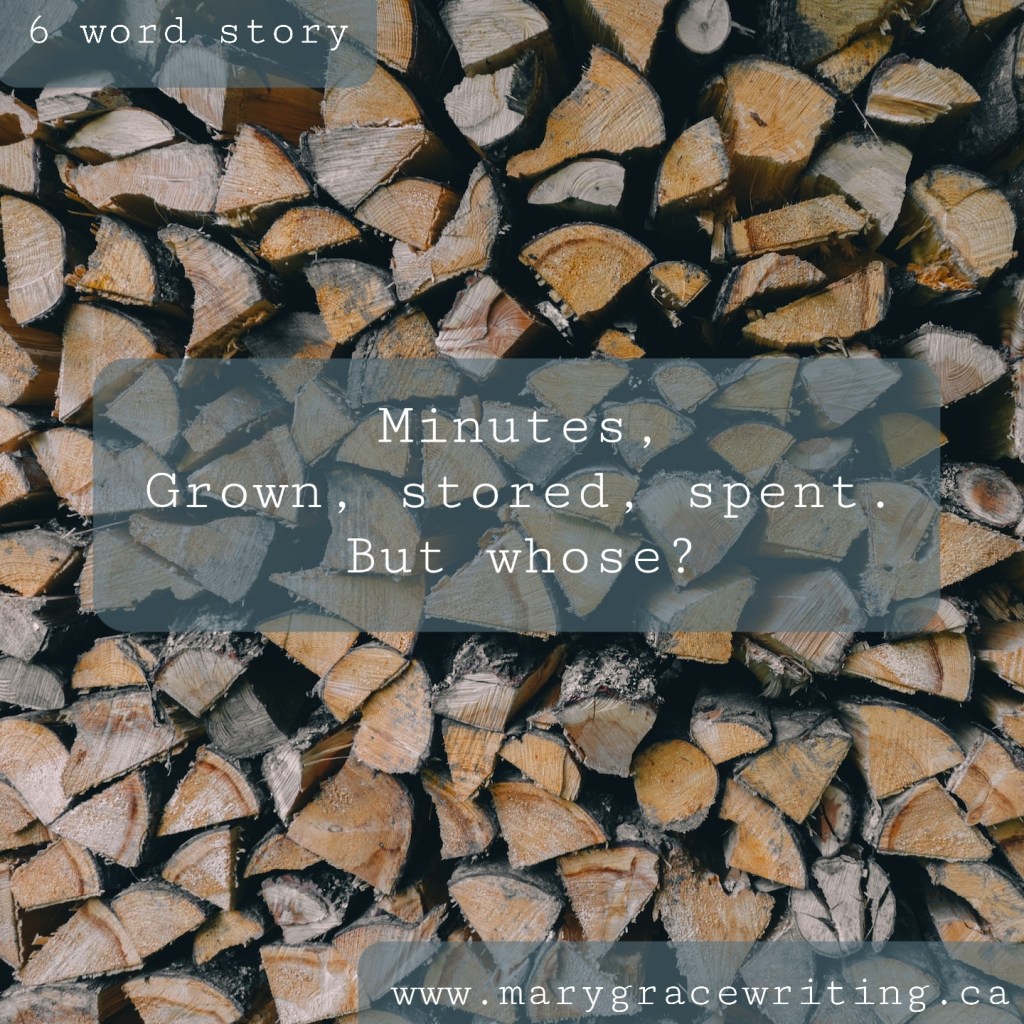
I use to get splinters as I stacked the wood my family used to heat our home in winter. Dad used gloves but I hated them. Even in winter, I preferred the feeling of bark against my skin, it gave my little hands a better grip.

First, we stacked it in rows behind the garage, then before winter we would all take turns loading the back of the truck, or even sleds with wood and moved it indoors, throwing it down the old-fashioned wood shoot. Once it was inside the word still wasn’t done, it needed to be stacked again to make more room for another load of wood. Back and forth back and forth…

We spent our time doing the necessary. Then when winter hit and the furnace was fired up we spent trees whose rings represent all the time they gathered into their trunks year after year, expanding, giving life to the world.

What a gift their end was to our family.

What a gift our time was to each other as we hauled each load and stored it for those cold Canadian months.

Each moment we spend time, but have you ever thought about whose time you are spending? It’s almost never just yours.

Copyrigt ยฉ2023 Mary Grace van der Kroef


Processingโ€ฆ
Success! You're on the list.

Find them HERE

Six Word Story (105)

I was given my first pair of glasses at the age of 5. They were purple, and the temple tips were made to wrap around a child’s ear and help hold them in place.

I also remember those first few weeks of using them. They were heavy, the strain hurt my eyes, and I didn’t like them.

But whether or not I liked them, I needed them. Soon I realized I didn’t have to squint all the time, and once I was used to the weight and the focus, my eyes hurt less than before I got them.

I couldn’t read yet but now I could SEE the words on a page and the letters that made them up, but only if I wore those glasses and chose to focus.

There is bounty in focus. But most of the time, it doesn’t come naturally, you have to learn it and chose it.

Copyright ยฉ2023 Mary Grace van der Kroef

Photo sourced from unsplash.com


Processingโ€ฆ
Success! You're on the list.

Available titles by Mary

Six Word Story (99)

The amazing intricacy of the world we live in is staggering.

The science, the art, the spiritual glue, it all connects and rolls together to the ticking of seconds.

It can seem eternal. As our brains measure time, maybe it is.

I do believe that someday there will be an end and time will run out, just as water evaporates from a cup.

But as evaporation is a kind of transformation, our earth, and us, will not really cease but simply change.

I believe God is the one who wrote the rules for these systems as he creates art.

What will he have us change into when the time comes?

I don’t know. But I can dream.

Copyright ยฉ2023 Mary Grace van der Kroef


Processingโ€ฆ
Success! You're on the list.

Six Word Story (97)

Life is a grinding down of moments, of mass.

Nature takes those fragments and transforms them into something new.

This happens with people too, physically, emotionally, and spiritually.

It’s so hard to see past the decay, the destruction.

But if we are brave enough to try, if we trust God has a plan in the middle of grief, we will be shown immeasurable beauty and potential.

He made nature this way for a reason after all.

ยฉ2022 Mary Grace van der Kroef

Photo sourced from unsplash.com


Processingโ€ฆ
Success! You're on the list.

Titles available by Mary Grace van der Kroef

Six Word Story (95)

Have you ever felt the wind beneath your wings?

Those moments in life when things are going well and the momentum lifts you high above the twisting paths and stones that trip others up?

Have you ever felt tired in those moments of success?

In those highs, we are still working.

The blessing in them is that if we spread out wings of trust they can carry us far while preserving our stamina.

But…

Holding wings open requires strength.

Ride the updrafts, but be vigilant in watching for those places of pause you still need.

ยฉ2022 Mary Grace van der Kroef

Photo sourced from unsplash.com


Processingโ€ฆ
Success! You're on the list.

Titles available by Mary Grace van der Kroef.